


Safety and Training at Home: Is It Worth It?
- Katherine Acrosphere coach
- Aug 27
- 4 min read
There is something truly fantastic about seeing a child discover a passion for circus.
They find an activity they love, become completely absorbed in learning new skills, and suddenly the aerial hoop, silks, trapeze or other equipment becomes the most exciting thing in the world. And as parents, it is wonderful to see that enthusiasm grow.
Of course, that enthusiasm can quickly lead to the question: “Can we get one at home?”
When you have seen how much they love aerial, investing in equipment can feel like a brilliant idea. But some aerial equipment can cost ££££, and more importantly, it is worth asking whether having access to it at home is actually safe or beneficial.
At Acrosphere, our advice is simple: we do not recommend having aerial equipment at home for children to practice on without professional supervision.

When should we draw the line?
Circus is exciting because it challenges the body in ways that many other activities don't. But that is also what makes it risky.
Aerial skills involve height, momentum, rotation, grip, body positioning and controlled landings. A skill that looks simple from the ground can require a huge amount of technical understanding to perform safely.
One of the biggest concerns with practicing aerial skills at home is that children may attempt something they have learned in class without a coach present to assess whether they are ready to perform it independently.
Even a small technical error can have consequences.
Landing incorrectly, losing a grip, entering a skill with the wrong body position or coming out of a move without enough control can result in injury. There is also the risk that a child becomes stuck or restricted in a position they don't yet understand how to safely exit.
Bad habits can be harder to fix than learning correctly in the first place
Another important consideration is technique.
Children are incredibly capable learners, but they are also very good at repeating what they practise. If they repeatedly perform a skill with poor technique at home, that movement pattern can become ingrained.
When they return to class, a coach may then have to spend valuable time unlearning and correcting a movement pattern before they can progress.
This can be frustrating for everyone.
Rather than moving forwards and developing the next exciting skill, the child may need to go back to basics and rebuild the technique correctly. In some cases, poor technique can also restrict their progression and make certain skills harder to learn later.
So while practicing more might seem like it will make them better faster, unsupervised practice isn't necessarily productive practice.
Could having aerial equipment at home take away some of the magic?
There is another side to this that isn't about physical safety at all.
Part of what makes circus class so exciting is that it is a special place where children get to explore, learn and achieve things they can't necessarily do anywhere else.
They arrive excited to discover what they will learn that week. They work towards a skill, celebrate their progress and share that experience with their friends and coaches.
If the same equipment is sitting in the garden or at home every day, that sense of anticipation can sometimes disappear.
What was once a special activity can start to feel ordinary.
Instead of thinking, “I can't wait for circus class so I can learn this!”, it can become, “I can just do it at home.”
And sometimes having constant access can actually reduce the motivation to attend class, rather than increase it.
So what can they do at home?
This doesn't mean that circus-loving children should sit still between classes!
In fact, there are lots of fantastic ways to support their aerial development without putting them on an aerial apparatus unsupervised.
Our advice is to speak to their coach.
Ask them to suggest a safe programme of exercises and conditioning that complements their aerial training. A good coach can recommend activities that develop strength, mobility, flexibility, coordination and body awareness without requiring the risks associated with aerial equipment.
There are also online tutorials and resources that can be useful when they focus on risk-free conditioning, movement and creative activities, rather than teaching children how to perform unsupervised aerial skills.
Get creative instead
At Acrosphere, we love encouraging young circus artists to take their training beyond simply learning tricks.
Head to your local park and practice
basic bar shapes and calisthenics. Work on conditioning exercises that your coach has recommended. Develop strength and control.
Flexibility work can also be fantastic when the body has been safely warmed up and children stay comfortably within their own limits. There is no need to force a range of motion or compete with anyone else.
And perhaps one of the best things they can do?
Create.
Make up choreography. Experiment with movement. Choose music. Explore characters and storytelling. Think about how a sequence could flow. Develop their own ideas and creativity.
These are all valuable parts of being a circus artist, and they don't require an aerial rig in the back garden.
Save the big skills for the professionals
There is something special about coming into class and hearing your coach say:
“Today, we're going to learn something new.”
The excitement, the challenge, the achievement and the feeling of finally getting a skill you've been working towards are all part of the circus experience.
Our goal isn't to discourage children's passion for circus. Quite the opposite.
We want to protect that passion while helping children develop safely.
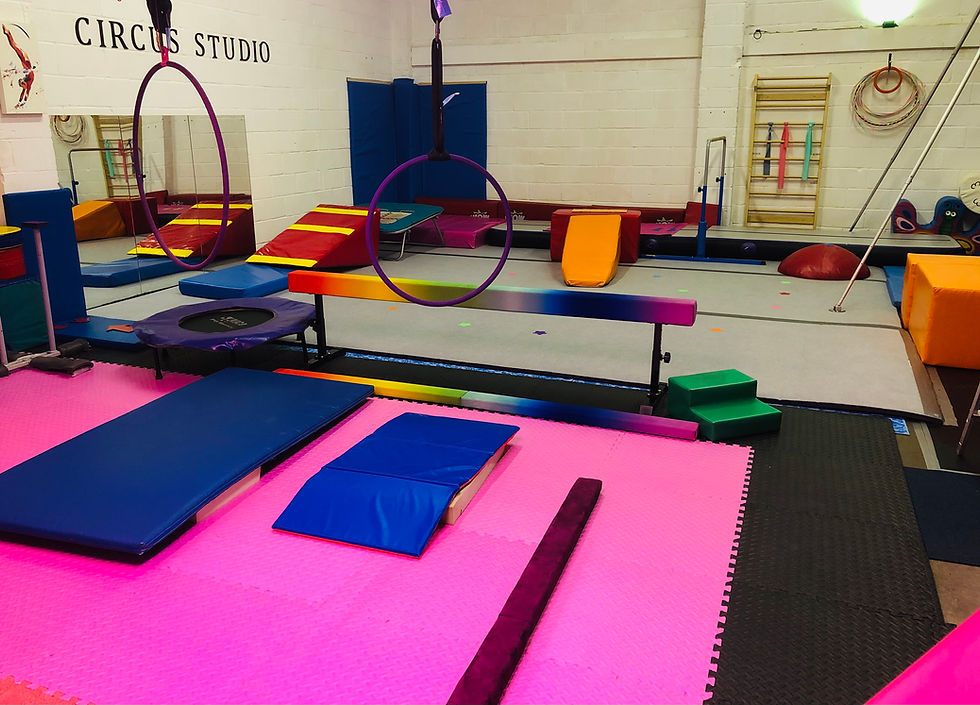
Use time outside class to build strength, conditioning, flexibility, creativity and body awareness. Then come into class ready to learn the exciting aerial skills with industry professionals and insured specialists who can assess readiness, teach appropriate technique, supervise the skill and provide the right environment for progression.
Because when it comes to circus, more practice isn't always better practice.
Sometimes the safest and most exciting thing you can do is leave the aerial equipment at the studio, keep building those foundations at home, and arrive at your next class ready to learn something amazing.


Comments